Garden fence types in Ireland
Wind and wet ground decide how long a fence lasts in the South East. Here are the main garden fence types Eddie puts up, what each one suits, and how a fence goes in with a driveway.
- Fencing: Timber and concrete
- Windy sites: Hit and miss or post and rail
- Lasts longest: Concrete posts and gravel boards
- Get a price: Free quote from Eddie
A fence takes more punishment in the South East than people give it credit for. It stands out in the wind all winter, it is wet for months at a time, and the bottom of it sits in damp ground. The type of fence you pick, and how well it is put in, decides whether it is still standing straight in a few years.
Eddie puts up timber and concrete fencing, often as part of a driveway job. Here is a plain run through of the main garden fence types and where each one suits.
What the weather does to a fence
Two things finish most fences early. The first is wind. A solid fence catches the wind like a sail, and in a strong gale all that force goes into the posts. If the posts are not deep enough or are starting to rot, the fence leans and eventually goes over.
The second is wet. Timber that stays damp rots, and the worst of it happens where wood meets the ground. A timber post set straight into wet soil, or a panel sitting on the grass, will rot from the bottom up long before the rest of it is worn out.
Most of what follows is about dealing with those two things.
Timber panels
Panel fencing is the most common fence in Irish gardens. Ready made panels slot or fix between posts, so it goes up quickly and gives you privacy straight away.
- Quick to put up, and a single panel is easy to replace if one gets damaged.
- Gives a solid screen for privacy.
- Catches the wind, so it needs strong posts set deep, especially on an open or exposed site.
- Needs a gravel board under it so the timber is kept off the ground.
Timber boards
Board fencing is built on site. Rails go between the posts and individual boards are fixed to them. It is stronger than most panels because it is built as one piece rather than in sections.
Closeboard fencing has the boards overlapping, which gives a solid, heavy screen. Hit and miss fencing has the boards fixed alternately on each side of the rails, with small gaps between them. You still cannot see through it from most angles, but the wind can pass through, which takes a lot of the strain off the posts. It also looks the same from both sides, which neighbours tend to like.
On a windy site, hit and miss is usually the better choice of the two.
Concrete posts and gravel boards
Whatever timber you put between them, the posts and the bottom of the fence do most of the work. Concrete posts do not rot, so the part of the fence that sits in the ground lasts. Slotted concrete posts take panels or boards in a channel, which also makes it easy to slide out a damaged panel and put in a new one.
A concrete gravel board runs along the bottom between the posts and keeps the timber clear of the ground. That one change stops the most common rot. For a back garden fence that has to last, concrete posts and gravel boards with timber above is hard to beat.
Post and rail
Post and rail is timber posts with two or three horizontal rails between them. It does not give privacy and is not meant to. It marks a boundary, keeps animals in or out, and lets the view through. It suits fields, paddocks, long frontages on rural houses and either side of a private lane. Wire can be added along it for stock.
Which fence for which boundary
A front boundary
A front fence is mostly about looks and marking the line. Keep it low enough that you can see out clearly when pulling onto the road. A low timber fence, a short run of post and rail, or posts with a gate between them all suit a front garden. If the fence runs beside the driveway, it should be planned with the driveway so the edges and the fence line up.
A back garden
Here privacy and shelter matter more. The usual choices are:
- Timber panels on concrete posts with gravel boards, for a tidy screen at a fair cost.
- Closeboard, where you want a heavy, solid fence.
- Hit and miss, where the garden is exposed to the wind.
A rural site
On a country house or farm the fencing often runs a long way. Post and rail is the usual choice along lanes and field boundaries, with a solid fence closer to the house where you want shelter or privacy. On an exposed site in Kilkenny or Waterford, going for a fence that lets the wind through is usually the better call.
Putting a fence in with a driveway job
A lot of the fencing Eddie does goes in alongside a new driveway, and there is good reason to do the two together.
One plan
The driveway edges, gates and fence line are set out together, so everything lines up.
Ground work once
The digging and levelling for the driveway and the post holes are done with the same machinery.
Posts set properly
Posts go deep enough for the site and are set in concrete.
Fence before the finish
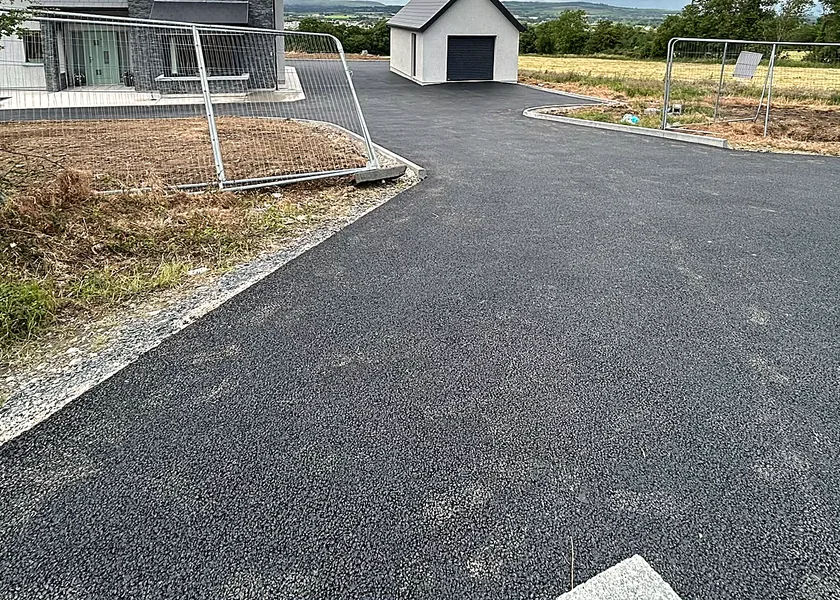
Where it makes sense the fence goes up before the final surface, so the new driveway is not marked by the fencing work.
Getting a quote
Eddie will look at the boundary, the ground and how exposed the site is, and tell you which fence he would put up and why. Quotes are free and there is no obligation. You can see more on our fencing page, or call Eddie on 087 120 4286.
Talk to Eddie about your driveway
Send a few details and Eddie rings you back with a free quote, anywhere across the South East.
Jobs around the South East
Get a free quote
More guides
Get a free quoteTar and chip driveway cost in Ireland
What decides the cost of a tar and chip driveway: length, base, access, chips and drainage, and how it compares with tarmacadam and gravel. Free quotes.
Tarmacadam vs block paving
Tarmacadam vs block paving on cost, look, upkeep, drainage and lifespan, and which suits a South East driveway. From Eddie, who lays tarmacadam.
Asphalt driveway cost in Ireland
Asphalt and tarmacadam are near enough the same on an Irish driveway. What decides the cost and what to look for in a quote. Free quotes from Eddie.
Tar and chip or tarmacadam: which suits a South East driveway
Tar and chip or tarmacadam: how to choose by length, budget, look, traffic and upkeep, with lanes and farm yards in mind. Eddie lays both. Free quotes.
Talk to Eddie about your driveway
Free quotes across the South East.