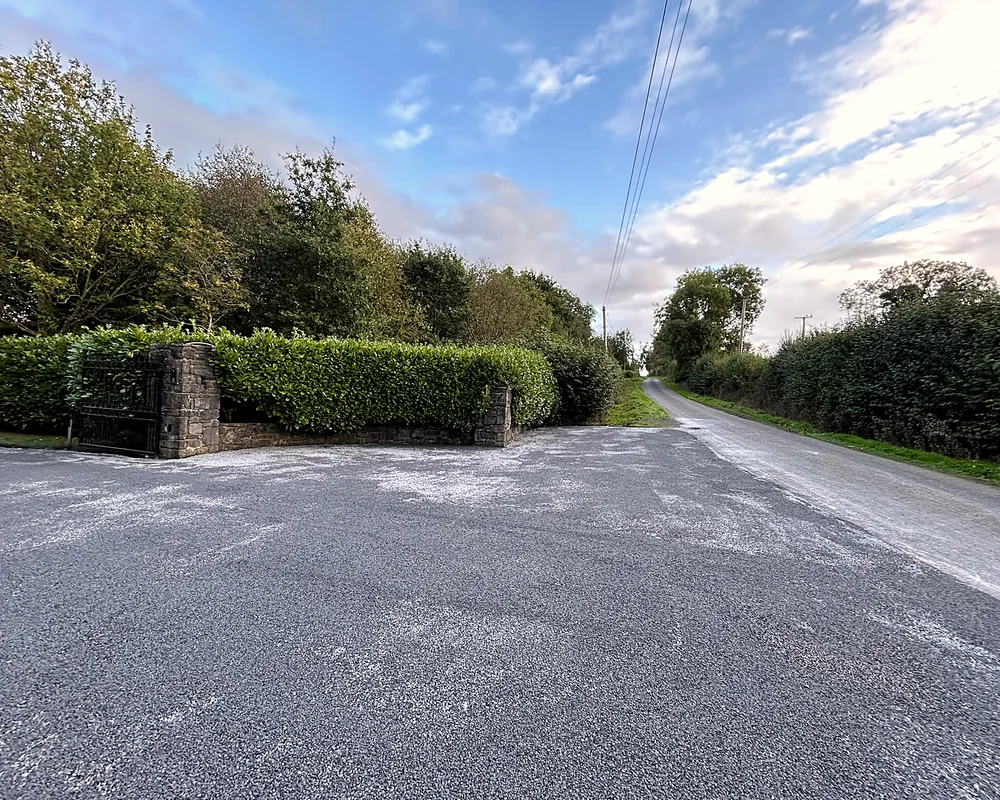
Tarmac driveway maintenance in Ireland
A tarmacadam driveway asks for very little, but the little it asks for matters in the wet South East. Here is what Eddie tells people to do each year, what to leave alone, and when a repair is worth it.
- Surface: Tarmacadam
- Each year: Sweep, clear the drains, check the edges
- Leave alone: Bleach, a close jet, heavy salting
- Get a price: Free quote from Eddie
A tarmacadam driveway is one of the easier surfaces to live with. It does not need much from you, but what it does need matters more here than in most places. The South East gets a lot of rain, the winters bring frost, and plenty of driveways sit under trees or in the shade of a house for half the day. Look after the few things below and a well laid driveway will stay tidy and sound for a long time.
Why tarmac wears faster in a wet climate
Tarmacadam is stone held together with bitumen. The bitumen is what keeps the surface tight and black. Water is its main enemy. When water sits on the surface, or gets into a small crack, it slowly loosens the grip the bitumen has on the stone. In winter that water freezes, expands and opens the crack a little wider. Do that over a few winters and a hairline crack becomes a loose patch.
Sun does its own damage. Over the years it dries the bitumen out, which is why an older driveway goes from black to grey. A grey driveway is not a failing driveway, but it is a sign the surface has lost some of its give.
Shade and leaves are the other part of it. Anywhere that stays damp, moss gets in, and moss holds more water against the surface. Across Kilkenny and Waterford the driveways that age worst are usually the ones under trees with no fall to shed the rain.
What to do each year
None of this needs special kit. A stiff brush and a bit of time does most of it.
- Sweep the driveway regularly, and more often in autumn when the leaves come down. Wet leaves left in a pile keep the surface damp and feed moss.
- Clear the gullies, channels and any drain at the gate or garage so rain runs off and does not pool.
- Walk the edges once a year and look for any spot where the tarmac is breaking away or the ground beside it has dropped.
- Wash off oil or diesel as soon as you see it, not at the weekend.
- Keep skips, trailers on stands and heavy machinery off the driveway where you can, or put boards down under them.
Moss and weeds
Moss is the most common thing people ask Eddie about. It is a cosmetic problem at first, but left alone the roots open up the surface and hold water in it.
Pick a dry spell
Moss treatment works best when the surface is dry and there is no rain due for a day or two.
Use a moss killer made for tarmac
Read the label. Avoid anything with bleach or acid in it.
Leave it to work
Give it time to turn the moss brown and dry.
Brush it off
A stiff brush lifts the dead moss out. Sweep it away rather than washing it into the gully.
Weeds coming up at the edges or along a joint are usually there because soil has got in. Pull them, brush the joint clean and keep an eye on it. Weeds coming up through the middle of the driveway are a different matter, and are covered in our guide to the signs your tarmac driveway needs replacing.
What to leave alone
Some of the usual fixes do more harm than the problem they are meant to solve.
- Bleach and strong household cleaners. They kill moss but they also eat the bitumen and leave the surface rough and pale.
- A pressure washer held close with a narrow jet. It can strip stone out of the surface, especially on an older driveway. If you use one, use a wide fan and keep it well back.
- Rock salt by the bagful in winter. A light scatter on an icy morning is fine. Heavy, repeated salting makes the freeze and thaw work harder on the surface.
- Sealing a new driveway. A new tarmac surface needs time to settle and does not need a sealer on it.
Edges and drainage
The edge is the weakest part of any tarmac driveway. If there is no kerb or proper edging, or the ground beside it has been dug out, the tarmac has nothing to hold against and it starts to break away. Parking right on the edge, or driving over it with a heavy van, speeds that up. If you can see the edge starting to crumble, it is worth getting it looked at before the damage moves inward.
Drainage is the other half. A driveway should have a fall so that water runs off it, into a gully, a channel or a soakaway. If you notice water lying in the same spot every time it rains, that spot will be the first to go. Sometimes the fix is as small as clearing a blocked drain. Sometimes it means a section of the driveway was laid without enough fall and needs to be lifted and relaid.
Oil and fuel spills
Bitumen comes from oil, so oil and fuel soften it. A small drip from the car is a stain. A real spill left to soak in will turn that patch soft.
Soak it up first
Use a cloth, sand or cat litter. Dab, do not rub.
Wash it with washing up liquid
Use warm water, not boiling, and a soft brush.
Rinse it off
Clean water, and let it dry.
If the surface has gone soft or sticky after a spill, washing will not bring it back. That patch needs to be cut out and repaired.
When a repair is worth it
A few fine cracks, a small hole near the gate, a short run of broken edge: these are repairs, and doing them early is far better than waiting. Water does not stop once it is in.
When the cracks spread across the driveway like a web, when potholes come back in the same spot, or when whole areas have sunk, a patch will not hold for long. That usually means the base underneath has gone, and the answer is to lift the surface and fix what is below it.
You do not need to work that out on your own. Eddie will come out, look at the driveway and tell you straight whether it needs a repair, a new surface or nothing at all yet. Quotes are free and there is no obligation. You can read more about how we lay a tarmacadam driveway, or call Eddie on 087 120 4286.
Talk to Eddie about your driveway
Send a few details and Eddie rings you back with a free quote, anywhere across the South East.
Jobs around the South East
Get a free quote
More guides
Get a free quoteTar and chip driveway cost in Ireland
What decides the cost of a tar and chip driveway: length, base, access, chips and drainage, and how it compares with tarmacadam and gravel. Free quotes.
Tarmacadam vs block paving
Tarmacadam vs block paving on cost, look, upkeep, drainage and lifespan, and which suits a South East driveway. From Eddie, who lays tarmacadam.
Asphalt driveway cost in Ireland
Asphalt and tarmacadam are near enough the same on an Irish driveway. What decides the cost and what to look for in a quote. Free quotes from Eddie.
Tar and chip or tarmacadam: which suits a South East driveway
Tar and chip or tarmacadam: how to choose by length, budget, look, traffic and upkeep, with lanes and farm yards in mind. Eddie lays both. Free quotes.
Talk to Eddie about your driveway
Free quotes across the South East.